Altus sits in cotton and wheat country near the Texas line, and it regularly posts some of the highest summer temperatures in Oklahoma. For a pier and beam house, that heat matters less in the crawl space air than in the soil itself. Long dry stretches pull water out of the clay well below the surface, and the ground shrinks away from footings.
Many homes in Altus were built in the decades after Altus Air Force Base opened, and a good number sit on pier and beam foundations with a brick or block perimeter. Interior piers carry a center beam, and the outside walls rest on a sill plate on top of that perimeter. When the soil shrinks at the edges, the outside walls drop and the interior stays higher.

Altus is one of the longer trips from our south Oklahoma City shop, so we plan dedicated inspection days for the area. We take floor elevations, look at every pier and the perimeter wall, and send a free written quote. Mark Bennett oversees every project, and if you will be away on assignment, we can share photos and talk through the plan by phone.
Why Altus Houses Settle at the Edges First
The outer few feet of soil around a house dry out faster than the soil under its middle. Sun hits the foundation, wind pulls moisture from bare ground, and trees or shrubs planted close to the wall draw water from the clay. As that outer ring shrinks, perimeter footings lose support and the house develops a dome shape, high in the center and low along the walls.
Uneven watering makes it worse. A section of foundation next to a heavily irrigated flower bed may stay swollen while the opposite side cracks open. Altus homeowners who water the lawn on one side only, or who have a dripping outdoor faucet in one corner, often see the house twist rather than settle evenly. Correcting the support only lasts when the soil moisture around the house is kept steadier.
Warning Signs in Altus Homes
- Floors that slope downward toward exterior walls, especially in corner bedrooms.
- Stair-step cracks in brick skirting or perimeter block on the sunny south and west sides.
- Windows that are hard to open or no longer lock in late summer.
- A gap between the bottom of exterior siding and the top of the perimeter wall.
- Interior walls near the center of the house with cracks at the ceiling line.
- Soil pulling away from the foundation with a visible gap during dry months.
Repair Options We Use in Altus
Perimeter wall and stem wall repair
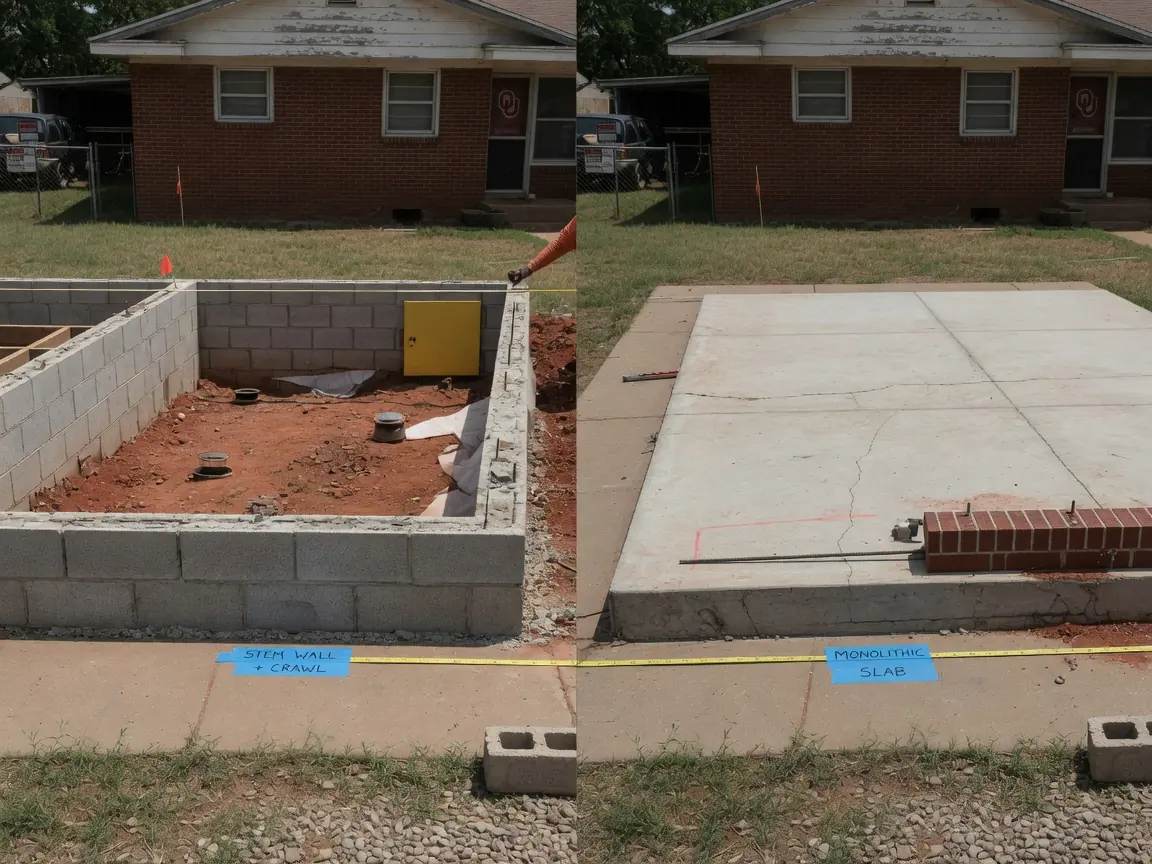
Cracked or settled brick and block perimeter walls are rebuilt or supported so the sill plate and outside walls have firm bearing again. This is the most common need in Altus homes that have dropped at the edges.
Adjustable steel support posts
Steel posts along the inside of the perimeter can pick up the floor framing where the old wall has sunk. They let us fine tune height later if the clay moves again after a severe drought.
Reshimming with steel shims
Interior piers that have stayed put often just need new steel shims to match the corrected perimeter height. This keeps the center of the house from becoming the new high spot.
Drainage correction around the foundation
Here this often means evening out how water reaches the soil: moving sprinkler heads, fixing a dripping spigot and directing downspouts away from the wall. Steady soil moisture protects the repair.
Cracked Brick Skirting and Perimeter Walls in Jackson County
Brick skirting and short block walls around the outside of Altus homes take the brunt of soil shrinkage. They crack in a stair-step pattern, lean outward or separate from the sill plate above. Some are purely decorative and carry no load, while others are the main support for the exterior walls. Telling the difference is one of the first things we do on an inspection.
When a perimeter wall carries load, we look at the footing below it, not just the cracks you can see. A wall rebuilt on the same shallow, shifting footing will crack again. The written quote explains whether we recommend rebuilding a section, adding support posts inside the wall line, or both. For moisture questions on the same home, our Altus crawl space page covers that side.
Pier and Beam Repair Cost in Altus
Perimeter wall work in Altus is quoted by section after we see the footing, so it is not priced by the foot here. Each adjustable steel post costs $300 to $900. Swapping crushed shims and making small height corrections falls in the $500 to $2,000 range. Sill plate repair is $100 to $300 per linear foot where the wood has failed. Typical leveling projects fall between $2,500 and $10,000, and every visit ends in a free written quote.
Moisture under the house too? See crawl space repair in Altus.