
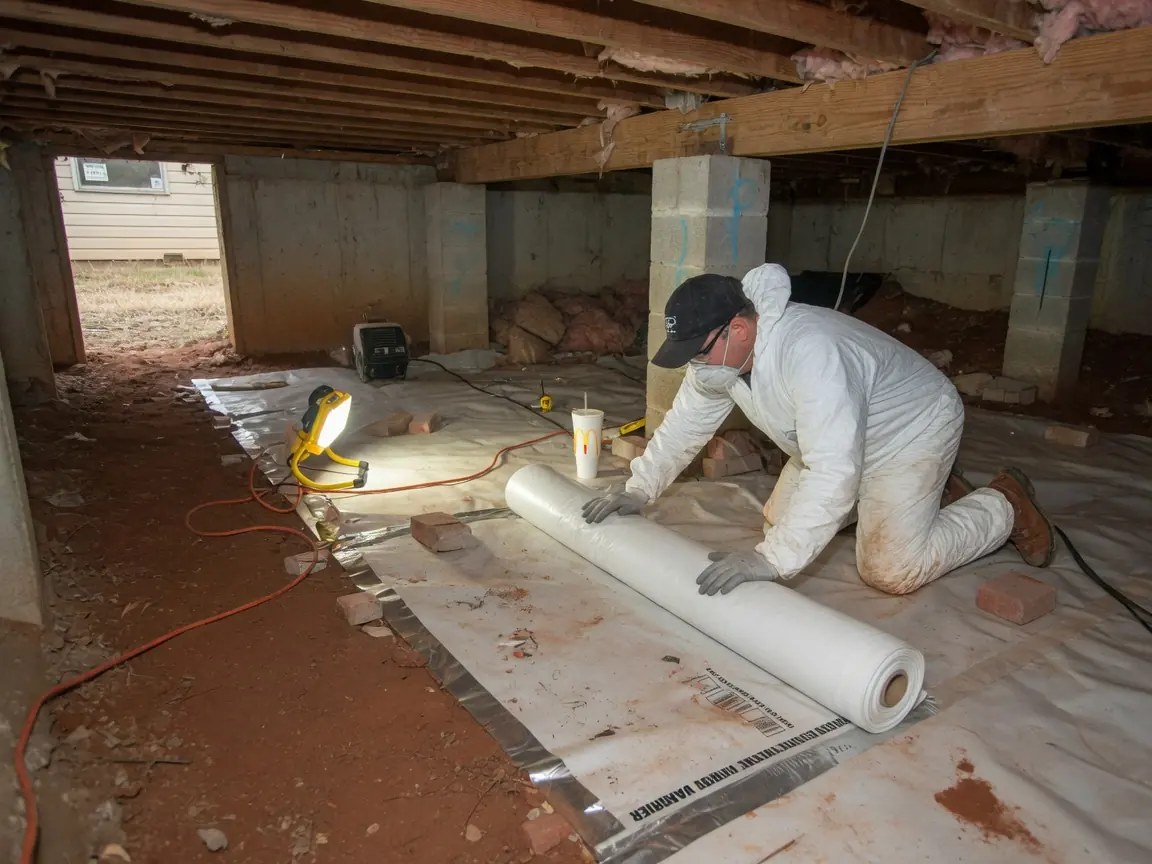
Bare soil under a house gives off moisture every day, even when it looks dry. In Oklahoma the clay can hold rain for weeks, and that water slowly evaporates into the crawl space and into the wood above it. A vapor barrier is a plastic ground cover that blocks that evaporation. It is one of the least expensive ways to protect the joists, subfloor and insulation in a crawl space home.
Many crawl spaces in the state have some kind of plastic already, but it is often thin, torn, bunched up or missing in large sections after decades of service calls. Old pier and beam houses from the early and middle 1900s may have no cover at all. A new barrier laid with overlapped and sealed seams, pulled up at the walls and cut snugly around piers, makes a measurable difference in wood moisture.
A vapor barrier can be a standalone upgrade in a vented crawl space or the first layer of a full encapsulation. During a free inspection we check soil moisture, humidity and drainage and tell you which approach fits your house. Every quote is written, and we schedule work statewide from our Oklahoma City shop.
Oklahoma tip: fix the low spots before the plastic goes down
Red clay settles into dips over time, and those dips hold water after storms. A liner laid over a low spot turns into a shallow pond. Rake the soil smooth and deal with drainage first so the barrier lies flat and water cannot collect on top.
Signs You Need Crawl Space Vapor Barrier Installation
- No plastic on the crawl space floor, or only scraps
- Torn, bunched or pushed-aside ground cover
- Damp soil or condensation on the underside of old plastic
- Wood moisture readings above about 19 percent
- A musty smell that gets worse after rain
- Insects and rodent activity in the crawl space
Choosing Thickness and Coverage
Thickness should match how the space is used. A 6 to 10 mil sheet is a reasonable basic ground cover in a crawl space that rarely sees foot traffic. If a plumber, HVAC technician or pest control crew will be crawling over it, or the soil has rocks and roots, a 12 to 20 mil reinforced liner resists punctures and lasts longer. Thin plastic tears easily and starts letting moisture through within a few years of service calls.
Installation matters as much as material. Seams should overlap generously and be sealed with tape made for the job, the edges should be carried up the foundation walls and fastened, and piers should be wrapped rather than trimmed around with wide gaps. A barrier in a vented space slows soil moisture but does not stop humid outdoor air. If summer humidity stays high after the barrier is in, the next step is crawl space encapsulation with a dehumidifier.
Crawl Space Vapor Barrier Installation Services We Help With
Standard ground cover
A 6 to 10 mil polyethylene sheet across the soil with sealed seams.
Reinforced liner
A 12 to 20 mil reinforced liner for spaces with service traffic or rough soil.
Wall and pier coverage
Barrier run up the foundation walls and wrapped around piers where the plan calls for it.
Old plastic and debris removal
Torn plastic, scrap wood and fallen insulation cleared out first.
Soil prep
Low spots raked out and sharp debris removed so the barrier lies flat.
Upgrade path to encapsulation
A barrier laid so it can be extended into a full sealed system later.
Crawl Space Vapor Barrier Installation Cost in Oklahoma
| Project | Typical Range | What Affects It |
|---|---|---|
| 6 to 10 mil ground cover | $1.00 to $1.75 per sq ft | Access, prep, number of piers |
| 12 to 20 mil reinforced liner | $1.50 to $2.50 per sq ft | Thickness, wall coverage, seams |
| Typical 1,200 sq ft crawl space | $1,500 to $3,000 | Material choice, cleanout needed |
| Old insulation and debris removal | $1.00 to $2.00 per sq ft | Amount of material to haul out |
| Full encapsulation if humidity stays high | $3.50 to $7.50 per sq ft | Includes walls, sealing and dehumidifier |
How It Works
- 1
Inspect and measure
We measure the crawl space, check soil and wood moisture and look for standing water.
- 2
Clear and prep
Old plastic and debris come out, and the soil is smoothed so the barrier lies flat.
- 3
Lay and seal
The barrier is rolled out, seams overlapped and taped, and edges and piers finished.
- 4
Walkthrough
We show you the finished barrier and photos of areas you cannot easily reach.