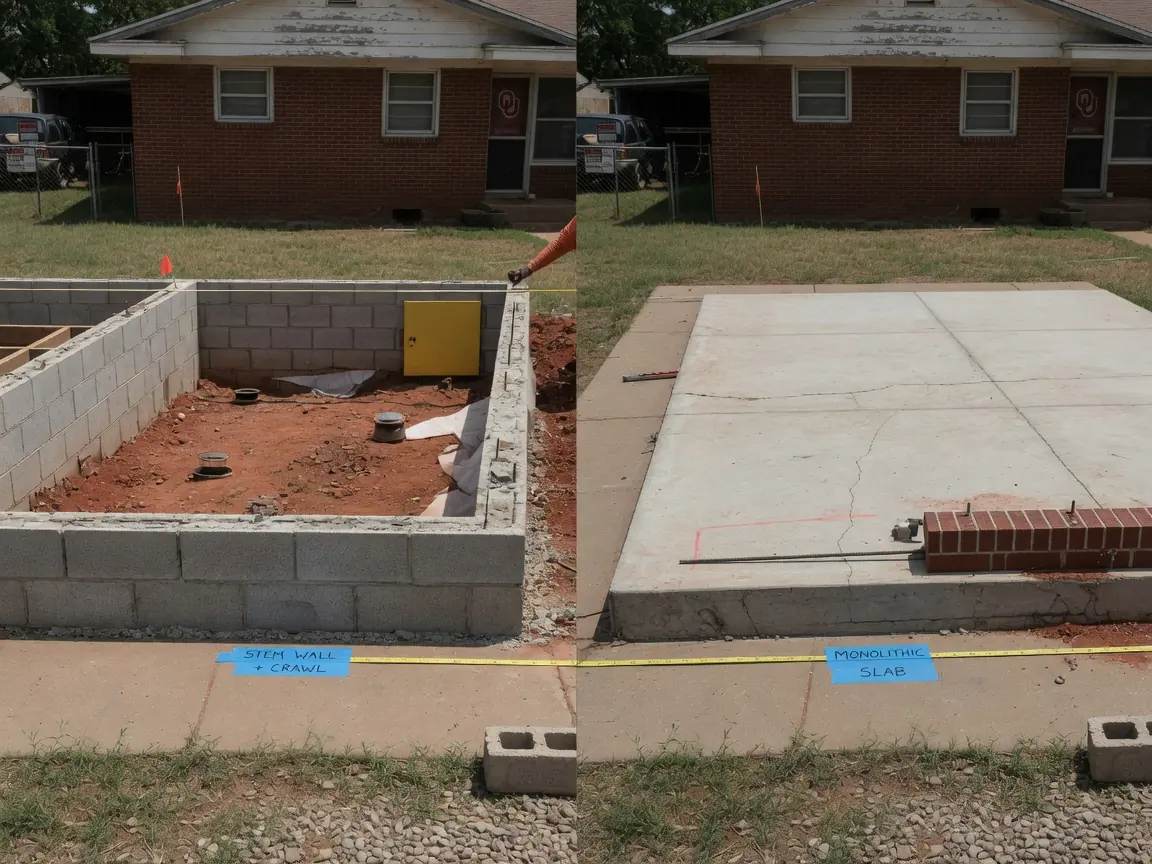
Choctaw covers a lot of rolling ground in eastern Oklahoma County, and many of its homes were built one at a time on lots that slope. A pier and beam house on a slope has a crawl space that is shallow on the uphill side and much taller on the downhill side, sometimes tall enough to stand in. The piers on that low side are longer and carry the same weight as the short ones, but with more room to lean.
Stepped footings are another feature of these homes. Where the ground drops, the perimeter footing steps down in sections, and each step is a place where the wall can crack if the soil below moves. Combined with the seasonal swelling and drying of the clay, that gives sloped-lot houses a distinct set of structural problems compared with homes on flat ground.

A free inspection looks at the house from both ends: the short uphill crawl space and the tall downhill one. We check each tall pier for plumb, look at the stepped footings for cracks and measure the floor across the slope. You get photos and a written plan. For drainage and moisture, see our Choctaw crawl space page.
Why Pier and Beam Homes on Choctaw Slopes Shift
Soil on a hillside tends to creep slowly downhill, especially clay that gets wet in spring and dries in summer. Tall piers on the downhill side are anchored in that moving soil, and as it shifts, their footings can tilt or slide a little. Because the pier is tall, a small tilt at the base becomes a large lean at the top, and the beam it carries drops or slides off its bearing.
The uphill side has the opposite problem. Water running down the slope soaks the soil against the uphill wall, which can swell and push against it or lift its footing. When the uphill side rises and the downhill side drops, the floor tilts in the direction of the slope, and the house slowly racks out of square.
Warning Signs in Choctaw Homes
- The floor slopes in the same direction as the lot, usually toward the downhill side of the house.
- Tall piers in the downhill part of the crawl space lean visibly or have cracks near the base.
- Cracks open in the foundation wall where the footing steps down to follow the slope.
- Deck boards or a downhill porch pull away from the house.
- Window and door corners on the downhill side show diagonal drywall cracks.
- The uphill wall of the crawl space is damp or shows horizontal cracking.
Repair Options We Use in Choctaw
Replacing tall downhill piers
Leaning or cracked tall piers are replaced with new piers on deeper, wider poured footings, often with bracing between them. This gives the downhill side of a Choctaw home the stable base it needs.
Stepped footing and stem wall repair
Cracks where the footing steps down are repaired and reinforced, and sections that have shifted are rebuilt. Fixing the wall at those steps keeps the perimeter moving as one piece.
Drainage correction on the uphill side
Gutters, buried downspout lines and a swale above the house steer runoff around the foundation instead of into the uphill wall. On sloped lots this is often what keeps a leveling repair from coming undone.
Adjustable steel posts for fine tuning
Where tall supports carry a beam over uneven ground, adjustable steel posts on solid footings make it possible to set each support precisely. They can also be adjusted later if the soil keeps creeping.
Tall Crawl Spaces and Stepped Foundations in Choctaw
A tall crawl space on the downhill side of a Choctaw home can seem like a bonus, since it is easy to move around in. Structurally, though, it is where most problems start. Tall piers need wider footings and sometimes cross bracing to stay plumb, and plenty of older homes were built with the same small footings uphill and downhill. Over decades the difference shows.
These tall spaces are also where outdoor water tends to run in after storms, and where clutter piles up against the supports. Keeping the area clear lets you see the piers, and keeping runoff out protects their footings. When we repair these homes, we plan the support work and the drainage together so the downhill side stays put.
Pier and Beam Repair Cost in Choctaw
Choctaw pier and beam costs depend heavily on how tall the downhill supports are and how much the slope affects drainage. New interior piers with footings cost $400 to $1,200 each, adjustable steel support posts $300 to $900 each, and regrading $500 to $2,500. A typical pier and beam leveling project runs $2,500 to $10,000, with sloped lots more often toward the upper part of that range. Every quote is free and written.
Moisture under the house too? See crawl space repair in Choctaw.