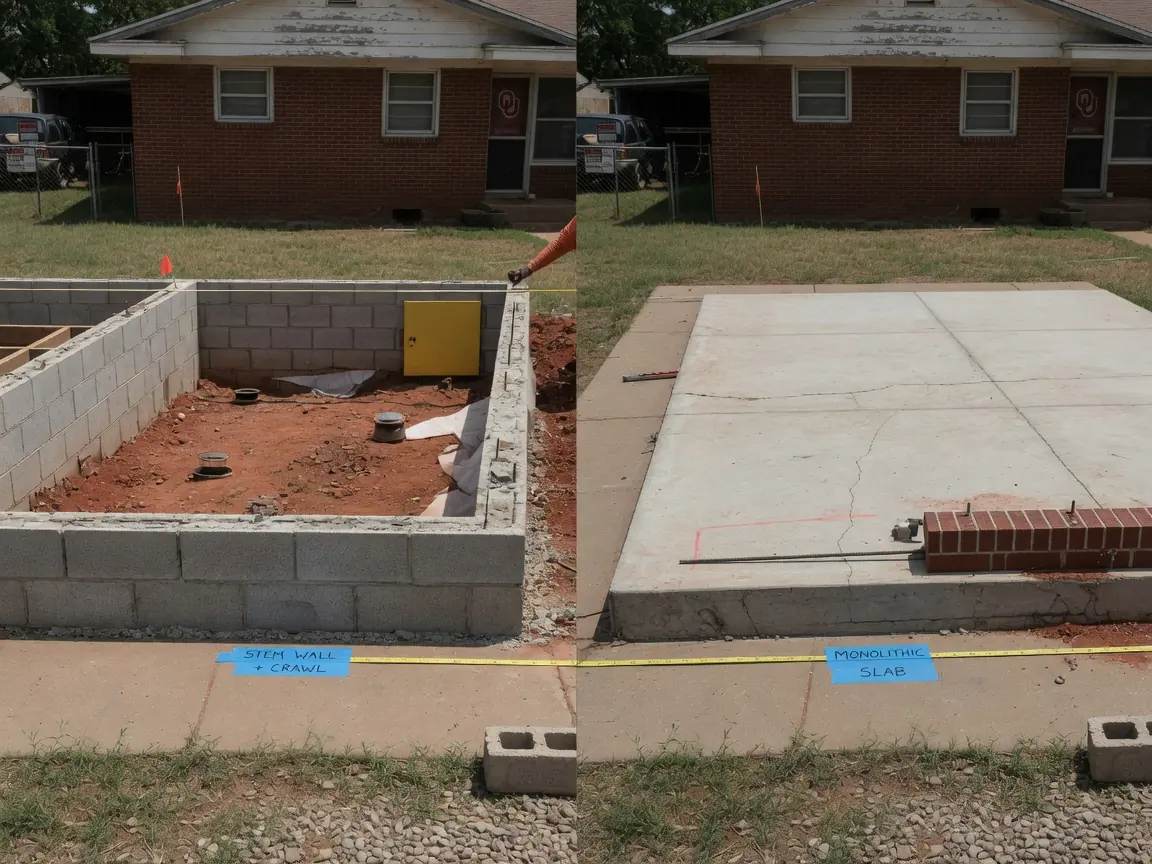
Most homes in Moore today are slabs, because so much of the city was built or rebuilt after the 1999 and 2013 tornadoes. The pier and beam houses that remain are mostly from the 1950s through the 1970s, scattered through the older parts of town on both sides of I-35. They are among the closest homes to our shop at 7220 S Western Ave, and they tend to show the same kinds of structural wear.
Interior piers in these homes were usually short concrete or block columns set on small pads, with wood shims driven between the pier and the beam. Decades later, many of those shims have dried out, split or slipped, and some pads have tilted as the clay beneath them dried and swelled. The result is a floor that rises and falls across a room, often along a line you can trace with your feet.

A free inspection gives you a floor elevation map, photos of each support and a clear list of what is loose, what is failing and what is still sound. Mark Bennett oversees every project, and we explain the structural options here and on our pier and beam foundation repair page.
What Makes Pier and Beam Homes in Moore Move
Moore sits on fairly level ground, and water that falls on a flat yard does not leave in a hurry. When it soaks the clay around a group of pier footings, those footings rise slightly; when the summer drought pulls the moisture back out, they drop. Piers near the perimeter and near downspouts see the biggest swings, so the floor near outside walls often moves more than the center.
Storms add a different kind of stress. High winds push sideways on a house, and a pier and beam home is held to its foundation mainly by its own weight and a set of anchor bolts at the perimeter. Even homes outside the worst damage paths can end up with interior piers nudged off plumb or shims knocked loose, which goes unnoticed until floors start to feel uneven months later.
Warning Signs in Moore Homes
- A floor in a Moore home bounces or rattles dishes in a cabinet when someone walks past.
- Floor registers or vent covers no longer sit flat because the floor around them has dropped.
- Cracks appear in the drywall over a hallway or along the top of an interior wall after a hard, dry summer.
- Windows that slid easily before a storm season now bind in their tracks.
- Through the access opening, you can see shims lying on the ground beside a pier instead of under the beam.
- Brick veneer outside shows a crack that widens near the bottom of the wall at one corner.
Repair Options We Use in Moore
Reshimming with steel shims
Where piers are sound but the wood shims have rotted, split or fallen out, we replace them with steel shims that will not crush or decay. It is the most common and least costly fix for older Moore homes with mild floor movement.
Perimeter stem wall repair
If a storm or years of wet clay has cracked or shifted the perimeter wall, that section is repaired or rebuilt and the sill reattached. This keeps the outside walls carried evenly before any interior leveling begins.
Adjustable steel support posts
Piers that have tilted on their pads are often replaced with adjustable steel posts on new pads. These let us fine tune the height of each support as the house comes back toward level.
Drainage correction around the foundation
On flat Moore lots, moving downspout water away and adding a gentle slope around the house keeps the clay under the perimeter piers from swinging so much between seasons. It protects the leveling work you just paid for.
Older Moore Homes Next to Rebuilt Neighbors
In parts of Moore, a 1960s pier and beam house may stand on the same street as homes rebuilt on new slabs after 2013. The older homes did not get that fresh start, and some of them carry quiet storm damage: anchor bolts that pulled loose, a perimeter section that cracked, or interior piers that shifted a fraction of an inch. Owners often notice nothing until a door starts sticking a year later.
If your house came through a tornado season with only cosmetic repairs, it is worth having the supports looked at once. We check whether every pier is still plumb and carrying weight, whether the sill is tight to the foundation and whether the floor has developed a new low spot. Most findings are modest, such as loose shims, but it is better to know.
Pier and Beam Repair Cost in Moore
Moore pier and beam work is often on the smaller side. Reshimming and minor leveling run $500 to $2,000, adjustable steel support posts $300 to $900 each, and drainage fixes such as downspout extensions and buried lines $300 to $2,000. When a perimeter section or several supports need work, a full leveling project typically runs $2,500 to $10,000. The free written quote breaks out each item so you can see what drives the total.
Moisture under the house too? See crawl space repair in Moore.