How to Repair a Block Foundation Under an Oklahoma Crawl Space

How Block Foundations Are Built
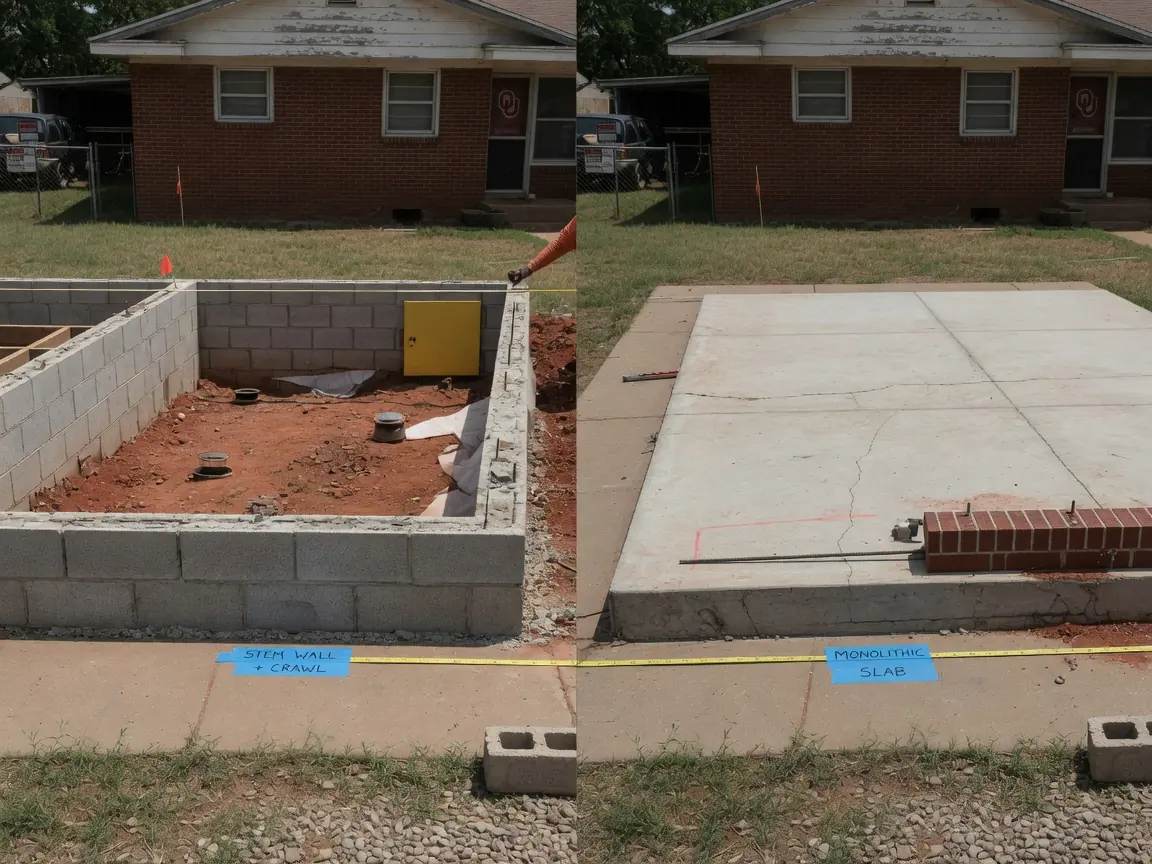
Many Oklahoma crawl space homes sit on a perimeter wall of concrete masonry units, the hollow gray blocks often called cinder blocks. The blocks rest on a concrete footing and are held together with mortar. The wall supports the outside edge of the house, while interior piers carry the middle.
Block walls are strong when pushed straight down but weaker against sideways pressure and uneven settling. Mortar joints are the weak point, which is why cracks in block walls usually follow the joints in a stair-step pattern.
Many older block walls were built without steel reinforcement or grout in the hollow cores. They hold up well when the soil around them is stable, but they have little reserve strength when the ground pushes or settles. Knowing how your wall was built helps decide whether a crack needs sealing or real reinforcement.
Common Problems
When you crawl under the house or walk the outside, these are the issues to look for:
- Stair-step cracks following mortar joints, often at corners or below windows
- Horizontal cracks along a mortar line partway up the wall
- Bowing or leaning where part of the wall pushes inward or outward
- Crumbling mortar that turns to sand when scratched
- Damp or white crusty block, a mineral deposit called efflorescence left as water passes through
- Rotted sill plate where the wood frame sits on top of the block
Some of these are minor. Others point to ongoing movement. The repair depends on which one you have and why.
What Causes the Damage
In Oklahoma, the usual causes are soil and water. Expansive clay pushes against the wall when it swells and pulls away when it dries. Water from roofs and poorly graded yards soaks the soil next to the wall, adding pressure and softening the ground under the footing.
Settlement under part of the footing causes stair-step cracking as one section drops. Horizontal cracks and bowing usually come from sideways soil pressure, which is more common where the outside grade is higher than the crawl space floor. For more on soil behavior, see Oklahoma red clay and your crawl space.
Judging How Serious It Is
A few simple observations help sort minor issues from serious ones. Hairline cracks that are not growing are often cosmetic. Cracks wider than about a quarter inch, cracks with one side offset from the other, and any visible bowing deserve a professional look.
Mark the ends of cracks with a pencil and the date, and check them over a few months. Also look at the floors above. If the floor near the wall is dropping or doors on that side of the house are sticking, the wall movement is affecting the structure.
A level or a straightedge held against the wall can show bowing that is hard to see by eye. Look along the top of the wall where the sill plate sits as well. If the sill has slid inward or the wall has separated from the framing above it, that is a sign of active pressure and should not wait.
Water stains, efflorescence and damp block tell you water is moving through the wall. That alone does not mean the wall is failing, but it does mean the soil outside stays wet, and wet clay is the main driver of the cracking and pushing described above.
What You Can Do Yourself
Some of the most effective steps cost little and do not require crawling under the house. Clean gutters and make sure downspouts carry water several feet away from the foundation. Look at the soil along the walls and add fill where it slopes toward the house. Keep shrubs and flower beds from holding water against the block.
Inside the crawl space, it is reasonable for a homeowner to mark cracks, take photos and watch for changes. Structural repairs to a block wall are a different matter. Removing blocks, rebuilding sections or installing anchors involves temporarily supporting the house, and mistakes can make the damage worse. Leave that work to someone who does it regularly and will put the plan in writing.
Repair Options
Tuckpointing. For loose or crumbling mortar without structural movement, old mortar is ground out and replaced. This restores the joints and slows water entry.
Crack sealing. Stable cracks can be filled to keep out water and pests. This does not fix movement, so it is only appropriate once the cause is handled.
Wall reinforcement. Bowing walls can be braced with steel or carbon fiber reinforcement, or stabilized with anchors set into the soil outside. Badly displaced sections may need to be taken down and rebuilt. These jobs vary a lot and should be quoted after an inspection.
Supporting a settled section. If the footing under part of the wall has dropped, the fix is support beneath it. Our article on steel piers vs concrete piers explains those options.
Sill and framing repair. Where water has rotted the sill plate on top of the wall, the damaged wood is cut out and replaced while the house is temporarily supported.
Typical Related Costs
Wall reinforcement and rebuilding are priced job by job. The framing and water control work that often comes with block wall repair falls into these ranges:
| Item | Typical Range |
|---|---|
| Sill plate repair | $100 to $300 per linear ft |
| Sistering a floor joist | $300 to $900 each |
| Downspout extensions and buried lines | $300 to $2,000 |
| Regrading | $500 to $2,500 |
| Interior perimeter drain | $30 to $70 per linear ft |
| Sump pump and basin | $1,200 to $2,500 |
Fix the Water First
No block repair lasts if water keeps soaking the soil against the wall. Before or alongside any structural work, extend downspouts, slope the soil away from the house and deal with any water entering the crawl space. Our crawl space waterproofing page covers those steps.
If you are seeing cracks or a leaning wall, a free inspection will show what is going on and what it will take. Mark Bennett oversees every project, and you will get a written quote with no obligation. We schedule inspections statewide, including pier and beam foundation repair in Stillwater. Call (405) 719-2657.
Want a free quote?
Call (405) 719-2657 or use the form for a free inspection and written quote.